
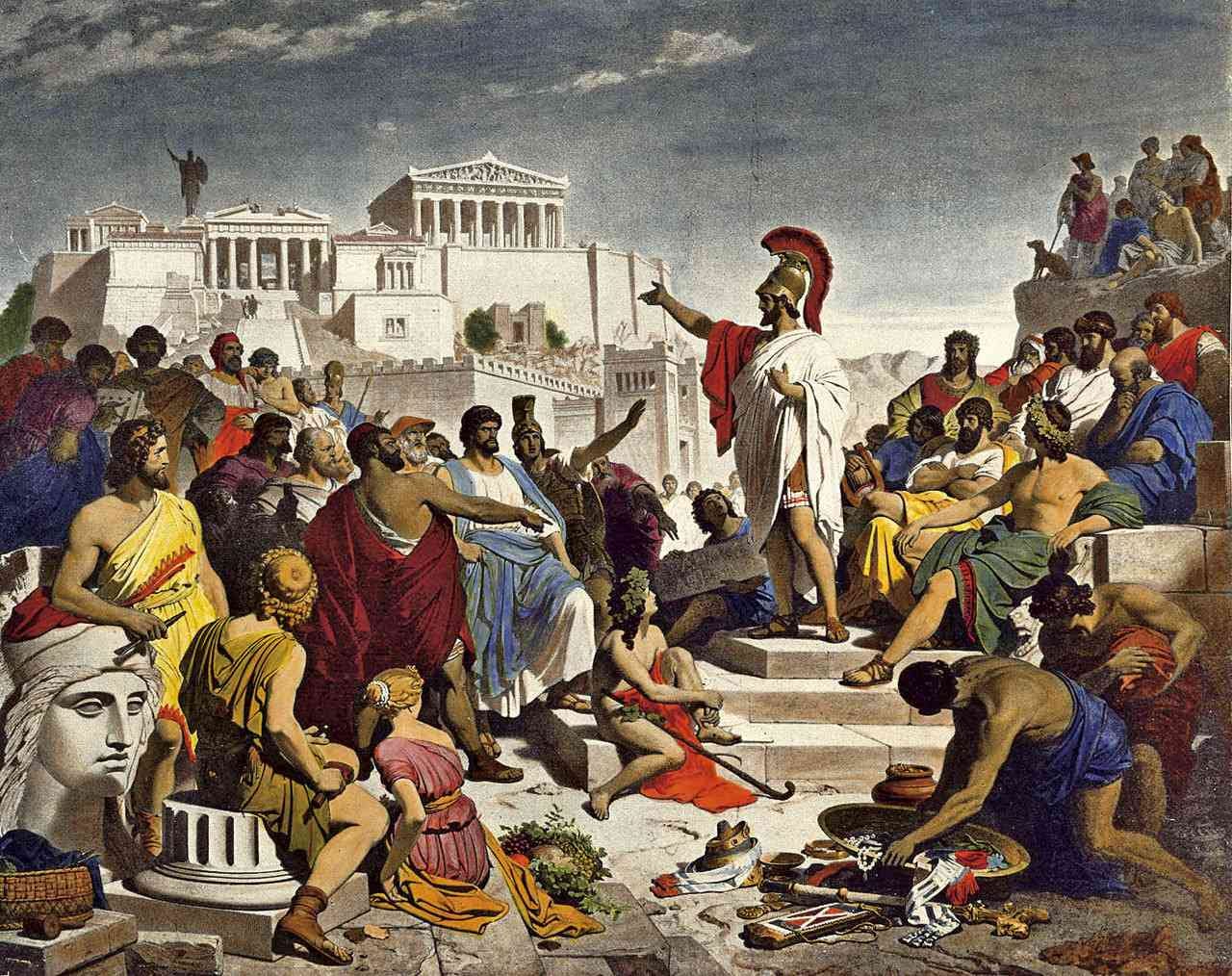
Across 2,500 years of history, a pattern reappears. Athens in the age of Pericles. Florence under the Medici. Silicon Valley today. Different continents and different centuries, yet the same phenomenon: concentrated wealth directed toward unproven visions, within competitive systems that bred innovation. These were the sparks that lit civilization’s brightest periods, and they may be glowing again in our time.
Athens and Florence: The First Renaissances
In 5th-century Athens, Pericles presided over a society that gave us philosophy, mathematics, history, drama, and democracy itself. The Greek world was divided into rival city-states. Athens contended with Sparta, Corinth, and Thebes. This rivalry compelled experimentation and encouraged risk. Each city sought to attract talent, not to imprison it.
Fifteen centuries later, Florence stood at the center of a second flowering. The Renaissance was financed by merchant-bankers like the Medici, who supported artists, architects, explorers, and political thinkers. Florence competed with Venice, Milan, and Rome much as Athens had with its neighbors. The struggle was intense, but the results were sublime: Michelangelo, Leonardo, Machiavelli, Galileo.
Two forces joined to make these bursts possible:
Decentralized competition through city-states
Wealthy elites willing to fund the future
Together, they produced some of the most brilliant ages in history.
The World We Inherited
Modern states do not look like Athens or Florence. Nation-states consolidated power, borders hardened, and federalism gave way to sprawling bureaucracies. Citizens ceased to be free movers. They became captives of geography. Governments no longer competed for people but for territory.
Yet the ancient formula is returning, though in a new form.
The Internet as the New City-State System
The internet now functions like the city-states of old. Instead of Athens or Florence, we have networks, protocols, online communities, and even emerging “network states.” They transcend geography and invite anyone who wishes to join.
For the first time in centuries, people can align more closely with their chosen networks than with their assigned nations. This marks the birth of the sovereign individual, a person who lives by choice rather than by passport.
The New Patrons of Genius
And once again, wealthy elites are underwriting bold experiments.
People like Elon Musk and Jeff Bezos are building rockets to make humanity multi-planetary.
Peter Thiel is funding projects in radical life extension, challenging the inevitability of death.
Others are advancing artificial intelligence, enlarging the frontier of mind itself.
Silicon Valley has become the Florence of our age. It channels concentrated wealth into ventures that governments would never attempt. Its patrons are the Medici of our time.
What They All Share
The pattern is unmistakable: when competition creates openness and wealth funds the seemingly impossible, genius flourishes.
Pericles turned Athens into the cultural capital of the ancient world.
The Medici transformed Florence into the engine of the Renaissance.
Silicon Valley today is underwriting civilization’s next experiments in space, in longevity, and in intelligence.
A Renaissance Without End
The bursts of Athens and Florence endured for centuries but eventually dimmed. Our Renaissance could be different. It could last indefinitely, if we choose to sustain it. The internet has revived competition. Patrons stand ready to fund the future. The sovereign individual is rising.
What Pericles, the Medici, and Musk have in common is not their time or their culture, but their role as catalysts. They lit the match. The challenge before us is to decide whether, in this age, the flame will flicker or whether it will blaze into a fire without end.
Follow me on X: @arjunkhemani
"Peter Thiel is funding projects in radical life extension, challenging the inevitability of death." Not quite. This is something I have to keep correcting in the prolongevity community. Success in radical life extension will not challenge the inevitability of death, only the inevitability of death by aging. Still plenty of ways for death to coming knocking on the door. This distinction matters because (a) we have to deal with reality, (b) talking of defeating death -- while appealing rhetorically and psychologically to us -- sparks opposition from religious types and humanists in a way that life extension does not (or does less).
Have you read the Medici Effect by Frans Johansson? Short book and one of my favorites. When great scientists, artists, and thinkers from different fields get together, a renaissance is created. Your article reminded me of it. Cheers!