
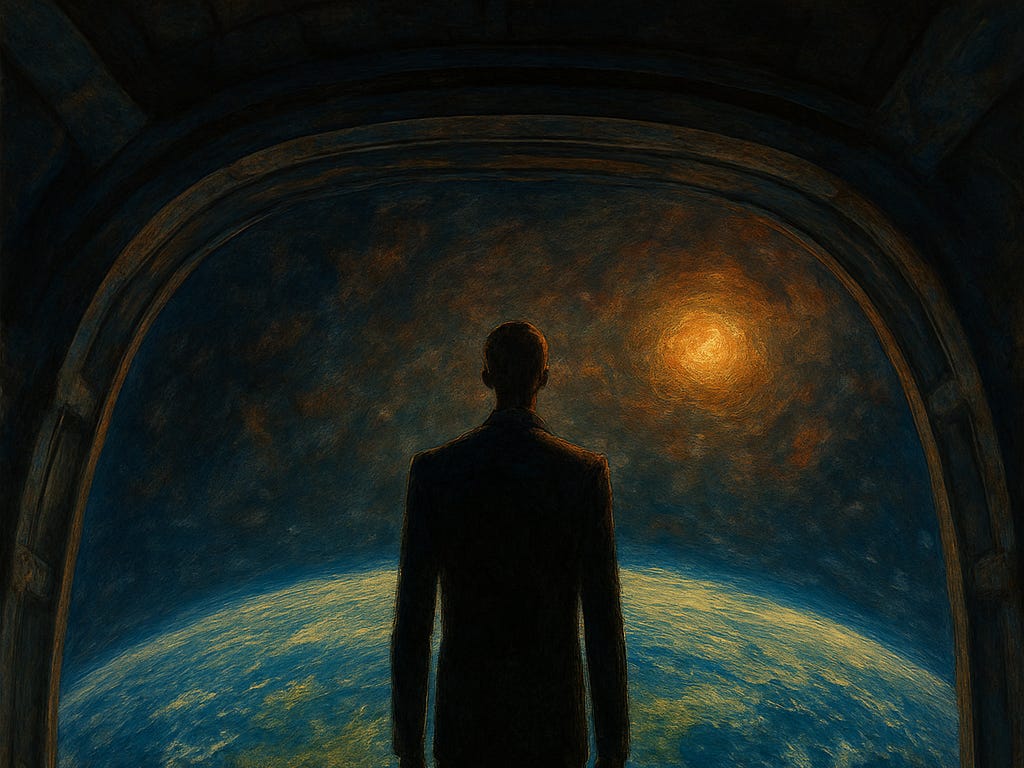
The viewport stretched wide, a cathedral of glass against the void. He stood there alone, tall, shoulders squared, a body carved into permanence by the twin miracles of biology and code. No gray in his hair, no weakness in his stride. Centuries had passed, yet he remained: unbroken, undefeated, immortal.
He remembered Earth as it had been: green and alive, clouds rolling thick with rain, the scent of soil rising after storms. The Garden was gone now. Not by apocalypse, not by the hands of builders, but by the weight of those who claimed to guard it. Bureaucrats fought their endless wars, choked the world with paper and steel, and in the struggle to hold power, they let paradise slip away. What was lost was innocence, and the illusion that Earth could endure under their watch.
He closed his eyes and let the past bleed back.
There had been enemies once, smooth talkers cloaked in concern. They promised safety by chaining progress, virtue by worshiping decay, equality by denying ambition. Socialism, degrowth, the prophets of AI doom: all preached surrender. They told mankind that greatness was a sin.
But greatness refused to die.
Tools were forged in secret, technology no state could throttle, no bureaucrat could seize. For the first time in centuries, the eye of Big Brother blinked and went dark. Freedom surged through the cracks like sunlight through stone. Capital flowed without chains, innovation without permission.
And when rockets roared upward, SpaceX painting fire across the sky, humanity followed. Mars, the Belt, the outer moons. Civilization unshackled, carried on pillars of steel and plasma. The builders had not destroyed Earth; they had simply walked away, choosing a horizon that could still hold life.
He remembered the day the last chain fell. The day humanity realized it would no longer apologize for its own existence. The day progress became unstoppable.
And yet…
Victory left scars. Eden Earth was lost, not to creation but to corruption. The forests that once hummed with life stood thin and hollow. The seas were restless, altered. He carried the memory of them like a wound that never closed.
Still, his own body was proof of what had been won. Partial reprogramming had stripped time from his cells. Peptides coursed through veins that would never clog. His heartbeat was steady, eternal. Death had been written out of him. He was the alpha of a new age, not because he conquered others, but because he refused to be conquered by decay.
Now he floated in silence, watching stars flare like ancient fires. Alone, but not despairing. Civilization had survived. Humanity had escaped the prophets of decline. The dream carried on, even if Eden had been left behind.
His reflection glimmered in the glass: strong, sharp, alive. He smiled, not the smile of joy, but of defiance. The world had been saved. The future belonged to builders, not beggars.
And in the void, he whispered it to the stars:
“This is only the beginning.”
Follow me on X: @arjunkhemani
Wow! Just Wow!
Nicely written - . But it somehow feels like a sad story.
You suggest that once humanity leaves Earth behind, the problems caused by “bureaucrats, prophets of decline, and beggars” disappear. But history shows that wherever people go, they bring their conflicts, their systems of power, and their blind spots with them. If paradise was “lost to corruption” once, why wouldn’t it be lost again on Mars, or the Belt, or beyond?
IMO escapism, whether through technology, colonization, or immortality, can delay problems but rarely solves them. It risks turning our attention away from the harder, more uncomfortable task: learning to build good societies where we are (however you define "good" - that's the problem - there's always a plurality of ideas what that means!). Otherwise, the old fractures reappear under new skies, only more dangerous, because now they stretch across planets or across centuries.
The danger, I think, is twofold:
1. Neglect of responsibility. If we believe salvation lies in flight, we may abandon the responsibility to repair what is broken here and now.
2. Repetition of cycles. Without deep transformation, ethical, social, and political, our “escape” becomes nothing more than exporting our unsolved problems into new frontiers.
Progress and exploration are vital, yes. But unless they are coupled with self-criticism and moral growth, they become another form of denial. Real greatness, it seems to me, isn’t in refusing decay, but in facing it, mending what can be mended, and creating anew without forgetting what was lost.